
Trivia Question❓What is the TFSA dollar limit for 2026? Answer at the bottom of the newsletter |
Newcomer Digest – Thursday's EditionBy the Newcomer Digest Team · A weekly guide for newcomers to Canada |
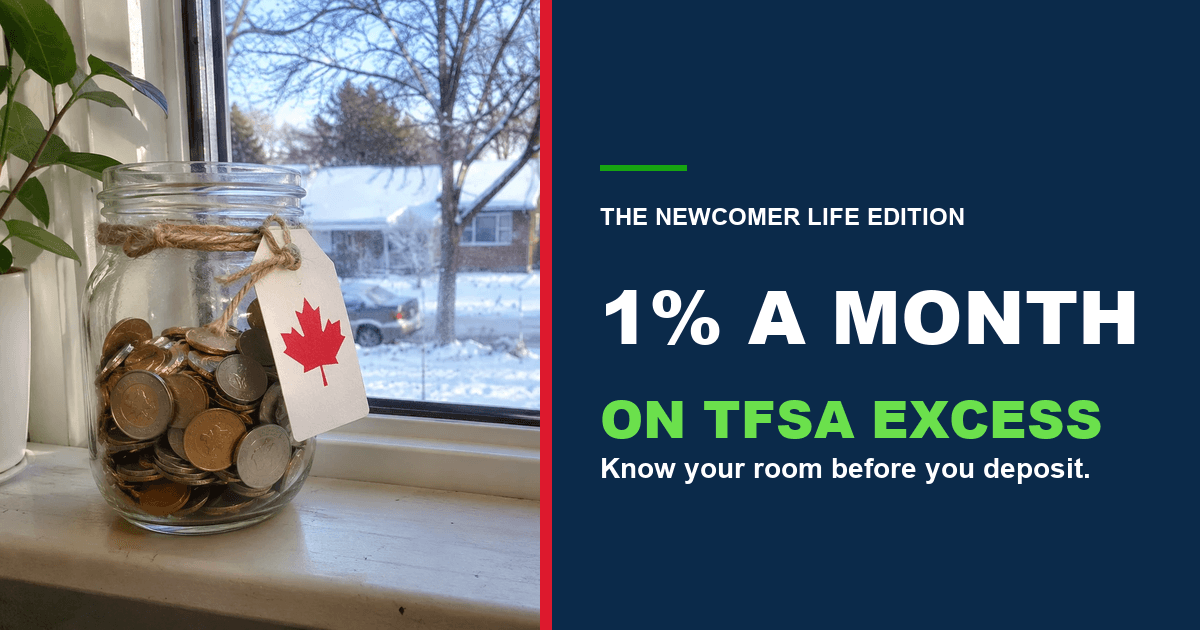
Your TFSA room starts the year you became a resident, at $7,000 for 2026. Put in more than your room and the CRA charges 1% a month on the excess. This week: 4 rules before your next deposit.
In this issue:
|
Featured Story |
Your TFSA Room Starts When You Arrive. 4 Rules.
Newcomers do not get room back to 2009. Over-contribute and the CRA charges 1% a month on the excess.
Know your room before you deposit.
Your bank app keeps suggesting a TFSA. A coworker says they put in tens of thousands. You have savings, and you want them to work.
Before you move money, know one thing. Your room is not the same as your coworker's.
The CRA says new residents start to build TFSA room on the day they have residency, if they are 18 or older. Not from 2009, when TFSAs began. Not from the year you turned 18.
To open one, the CRA says you must be a resident of Canada for income tax purposes, 18 or older, with a valid SIN. Some provinces use 19.
The dollar limit is $7,000 for 2025 and $7,000 for 2026. The CRA has not posted the 2027 limit on the pages we checked.
Your room has a start date. Know it before you deposit.
|
What This Means for You |
How newcomer room works, and where people slip
Where people commonly go wrong (all from CRA pages):
General information, not tax or financial advice. Review the official CRA pages before you make a decision. |
What You Can Do Now |

Four rules before your next deposit
|
Helpful Resource |
The official CRA pages behind this issue
Every fact above comes from these Canada Revenue Agency pages, checked November 25, 2026. |
Work with a consultant |
Planning your savings around a permit or a move to PR? A consultation looks at your own dates and options.
Know your options. Plan your next step.
Have questions about your immigration status, an expiring permit or your family’s next move?
Get personal guidance from Melisa Alexander, Licensed Canadian Immigration Consultant (RCIC), R531703, in a private 60-minute video consultation. Verify me, or any consultant, on the College’s public register.
We’ll focus on:
After the call, you get a consultation summary.
CAD $250 · 60 minutes Book your immigration consultation →
To make the most of your session, have your status documents, key dates and top three questions ready. |
From the publisher |
Today's newsletter is brought to you by: |
How does your child learn best?
Answer 7 quick questions and get a free, personalized study-style report by email. No login needed.
Then talk to certified teachers about a plan that fits: online tutoring, or in-home tutoring in Edmonton.
8-year Consumer Choice Award winner, Northern Alberta
|
💡 Answer to Trivia Question: $7,000, according to the Canada Revenue Agency. |
Before you go
Every newcomer has questions that nobody answers clearly. We answer them one at a time, in plain language, with sources you can check.
Your turn. Did you know your TFSA room starts the year you became a resident? Reply with one word: yes or no. Your replies shape what we write next.
Know someone who just opened a TFSA? Forward this email to them. It's the best way to help.
Missed an issue? Read them all at newcomerdigest.com/archives.
P.S. Want a licensed consultant to look at your own dates and options? Book your immigration consultation → CAD $250, 60 minutes, Google Meet. A consultation is not a guarantee of any immigration outcome. |