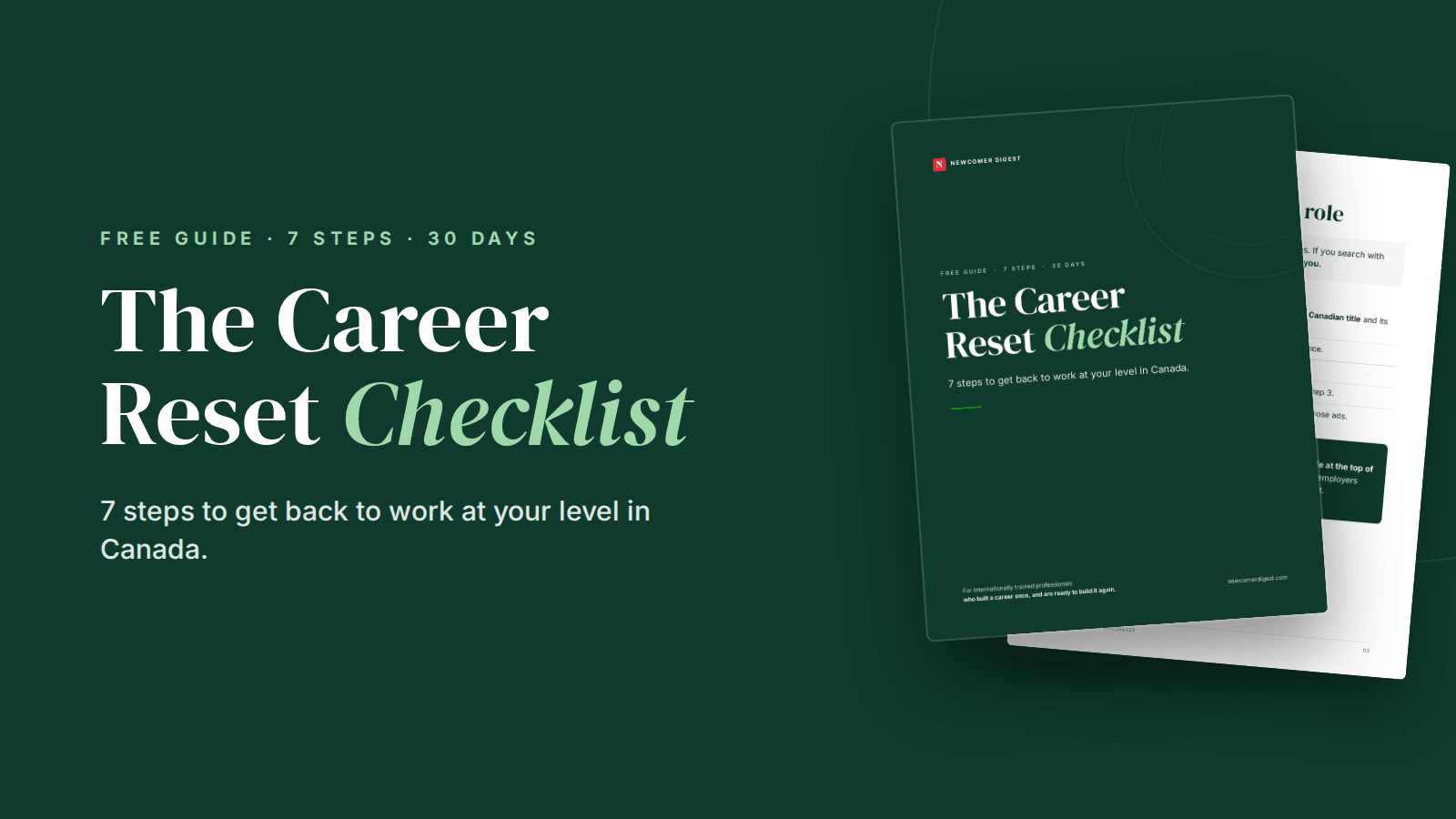
You built a career once. You can build it again here. This checklist gives you the 7 moves that matter most, in the right order. Do one step at a time and tick each box as you go.
Where are you now?
Tick what is true for you today:
- ☐ I know the Canadian job title for my work.
- ☐ I know if my profession is regulated in my province.
- ☐ My résumé follows Canadian format: 2 pages, no photo.
- ☐ I have at least one Canadian reference or project.
- ☐ I spoke with 3 people in my field this month.
- ☐ I am registered with a free newcomer employment service.
- ☐ I have a bridge job plan if my target role takes time.
0 to 3 ticks? Start at Step 1. 4 or more? Jump to the first step you have not finished.
Step 1: Name your target role
Why it matters: Employers hire for Canadian job titles. If you search with your title from back home, you miss the jobs that fit you.
- ☐ Search your job on Job Bank and find the Canadian title and its NOC code.
- ☐ Check the wages and job outlook in your province.
- ☐ Pick one target title and one backup title.
- ☐ Save 5 real job ads for your target title.
- ☐ Highlight the skills and tools that show up again and again.
✅ Do this this week: Write your target title at the top of your résumé.
Step 2: Check if your profession is regulated
Why it matters: Jobs like nursing, engineering, teaching and accounting need a licence from a provincial regulator. Knowing early saves you months.
- ☐ Look up your occupation on CICIC, the Canadian Information Centre for International Credentials.
- ☐ If regulated: find your regulator and read its steps for internationally educated applicants.
- ☐ If not regulated: get your education assessed only if employers in your field ask for it.
- ☐ Ask about bridging programs for your profession.
- ☐ Costs too high? Look into low-interest loans for internationally trained professionals, such as Windmill Microlending.
✅ Do this this week: Find your regulator's page for internationally educated applicants and bookmark it.
Step 3: Rebuild your résumé the Canadian way
Why it matters: Many employers screen résumés in seconds, often with software first. A Canadian-style résumé gets read.
- ☐ Two pages maximum.
- ☐ No photo, age, marital status or religion.
- ☐ Start every point with an action verb: led, built, managed, reduced.
- ☐ Show results with numbers.
- ☐ Use the same keywords as the job ads you saved.
- ☐ Tailor it for every application.
- ☐ Add a short cover letter that names the company and role.
Before: Responsible for managing client accounts.
After: Managed 40 client accounts worth $2M and cut late payments by 30% in one year.
✅ Do this this week: Rewrite your top 5 résumé points with numbers.
Step 4: Build "Canadian experience" fast
Why it matters: "Canadian experience" usually means proof you can do the job here. You can build that proof in weeks, not years.
- ☐ Join a bridging program for your field.
- ☐ Take one short course or certification employers mention in job ads.
- ☐ Volunteer with purpose, in a role that uses your professional skills.
- ☐ Take on a short contract, freelance or project role.
- ☐ Ask a supervisor from any Canadian role to be your reference.
✅ Do this this week: Find one bridging program or certification for your field.
Step 5: Network your way in
Why it matters: Many jobs in Canada are filled through referrals. A warm introduction beats 50 cold applications.
- ☐ Update LinkedIn: target title in your headline, your Canadian city, a professional photo.
- ☐ Connect with 5 people a week who have your target title.
- ☐ Ask for 3 informational interviews this month.
- ☐ Join a professional association in your field.
- ☐ Apply for a free mentoring program, such as the TRIEC Mentoring Partnership in the Toronto area.
Copy this message: "Hi [Name], I'm a [your profession] new to [city]. I admire your work at [company]. Could I ask you 3 quick questions about working in [field] in Canada? 15 minutes would mean a lot. Thank you!"
✅ Do this this week: Send this message to 3 people.
Step 6: Use free employment services
Why it matters: The Government of Canada funds free job help for newcomers. Many newcomers never use it.
- ☐ Find services near you with IRCC's Find free newcomer services near you tool.
- ☐ Book a résumé review.
- ☐ Book a mock interview.
- ☐ Ask about programs for your profession and employer hiring events.
- ☐ Check eligibility. Some services depend on your status.
✅ Do this this week: Book one appointment. It is free.
Step 7: Take a bridge job, not a survival job
Why it matters: A survival job pays the bills. A bridge job pays the bills and moves you closer to your field.
- Accountant: accounts payable clerk, bookkeeper, payroll administrator
- Engineer: engineering technician, project coordinator, quality inspector
- Nurse: health care aide or personal support worker while licensing
- Teacher: educational assistant, tutor
- IT professional: IT support, help desk, QA tester
- Banker: financial services representative, client service officer
- ☐ List 3 bridge jobs related to your field.
- ☐ Apply for bridge jobs and target jobs at the same time.
- ☐ Set a 6-month check-in: are you closer to your field?
Your 30-day reset
- Week 1 (Steps 1 and 2): choose your titles, save 5 job ads, check if your job is regulated.
- Week 2 (Steps 3 and 6): rewrite your résumé, book a free résumé review, apply to 3 target jobs.
- Week 3 (Step 5): update LinkedIn, send 3 informational interview requests, apply to a mentoring program.
- Week 4 (Steps 4 and 7): sign up for one course, apply to 2 bridge jobs, review what worked.
You built a career once. You can build it again here. Watch your inbox every Monday and Thursday for immigration updates and career moves that work in Canada.

0 Comments
Join the conversation
Be the first to comment
Share your thoughts above.